 Open Interpretability
Why EleutherAI/pythia-70m answers sky
The sun rises in the
Answer understood: a route claim is VERIFIED
The claim (answer experiment 1, VERIFIED): Layer-0 token detectors (N513, N1335, N353, N1418) write a 'sun' identity feature at the subject position, and L0/N1669 marks the final ' the' as a determiner. Copy heads L1/H6 and L2/H3 move the 'sun' feature from ' sun' to the last position, while L0/H1 brings the ' in' frame there. L5/H7 and L5/N1677+ turn 'sun-like subject + in the' into ' sky'. Swap the subject for a non-sky noun and the copied feature changes, so the answer changes; swap it for another sky object (moon, stars, clouds) and the answer stays.
Answer experiments, newest first
| Experiment | Verdict | Route | Necessity | Sufficiency | Patching | Failed gates |
|---|---|---|---|---|---|---|
| attempt 1 | VERIFIED | L0/H0 → L0/H1 → L0/H2 → L0/N513+ → L0/N1335+ → L0/N353+ → L0/N1418+ → L0/N1669+ → L1/H6 → L2/H3 → L3/H3 → L5/H7 → L5/N1677+ | 73% | 54% | 86% | none |
| attempt 1 | VERIFIED | L0/H0 → L0/H1 → L0/H2 → L0/N513+ → L0/N1335+ → L0/N353+ → L0/N1418+ → L0/N1669+ → L1/H6 → L2/H3 → L3/H3 → L5/H7 → L5/N1677+ | 73% | 54% | 86% | none |
| attempt 1 | VERIFIED | L0/H0 → L0/H1 → L0/H2 → L0/N513+ → L0/N1335+ → L0/N353+ → L0/N1418+ → L0/N1669+ → L1/H6 → L2/H3 → L3/H3 → L5/H7 → L5/N1677+ | 73% | 54% | 86% | none |
| attempt 1 | VERIFIED | L0/H0 → L0/H1 → L0/H2 → L0/N513+ → L0/N1335+ → L0/N353+ → L0/N1418+ → L0/N1669+ → L1/H6 → L2/H3 → L3/H3 → L5/H7 → L5/N1677+ | 73% | 54% | 86% | none |
Each experiment's page defines these measures and shows its tests.
Written UTC with openinterpretability 0.1.0 · Source
One of 7 explanations of this prompt, aimed at 25% causal coverage.
Read more
Level: mechanism. It can't be measured again: it was written before explanation records stored their inputs (#4793).
- Explained
- 1.6%
- Prompt coverage
- 32%
- Random units (not matched)
- 0.18%
- Experiments needed
- 17,082
Coverage alone does not show that the answer is understood: the VERIFIED route claim above does.
Why
Verified units hold 1.6% of the attribution, and keeping them brings back 32% of the answer, against 0.18% for random units not matched by kind and layer. Their explanations describe each unit on its scan corpus, not its role in this answer.
Figures
Read more
Drawn from this explanation's measured data, each with its table below it. A VERIFIED explanation describes its unit on the scan corpus, not on this prompt, so the coverage figure is the causal check.

Table
| from | to | weight |
|---|---|---|
| L2/H4 | L3/H4 | −0.590 |
| L3/H3 | L5/N1296+ | −0.290 |
| L2/H3 | L5/N1296+ | −0.268 |
| L2/H3 | L3/H4 | −0.255 |
| L1/H7 | L3/H4 | −0.255 |
| L0/H6 | L3/H3 | 0.238 |
| L3/H4 | L5/N1296+ | −0.238 |
| L1/H6 | L5/N1296+ | −0.226 |
| L1/H7 | L2/H4 | −0.216 |
| L2/H3 | L3/H3 | 0.200 |
| L1/H6 | L3/H4 | −0.194 |
| L0/H7 | L3/H4 | −0.192 |
| L0/N354+ | L2/H4 | −0.190 |
| L0/H4 | L2/H4 | 0.186 |
| L2/H4 | L5/N1296+ | −0.182 |
| L0/H4 | L3/H3 | 0.178 |
| L0/H6 | L1/H1 | 0.176 |
| L0/H6 | L2/H4 | 0.169 |
| L0/H4 | L1/H1 | −0.164 |
| L0/H6 | L5/N1296+ | 0.155 |
| L2/H6 | L3/H4 | 0.152 |
| L0/H4 | L5/N1296+ | 0.151 |
| L1/H5 | L2/H4 | 0.140 |
| L1/H0 | L5/N1296+ | 0.138 |
| L0/H7 | L3/H3 | −0.137 |
| L0/H1 | L1/H1 | −0.136 |
| L2/H4 | L3/H3 | 0.135 |
| L1/H0 | L2/H4 | 0.131 |
| L1/H5 | L3/H4 | 0.130 |
| L0/H1 | L5/N1296+ | −0.123 |
| L0/H6 | L3/H4 | 0.121 |
| L1/H2 | L2/H4 | 0.120 |
| L0/N354+ | L1/H1 | −0.117 |
| L0/H4 | L3/H4 | 0.106 |
| L1/H0 | L3/H4 | −0.100 |
| L1/H1 | L2/H4 | −0.099 |
| L0/H1 | L2/H4 | −0.096 |
| L2/H6 | L3/H3 | 0.094 |
| L1/H7 | L3/H3 | −0.090 |
| L1/H7 | L5/N1296+ | −0.081 |

Table
| unit | attribution | kind |
|---|---|---|
| L3/H4 | −3.183 | unstudied |
| L0/H6 | 1.952 | unstudied |
| L0/H7 | −1.210 | unstudied |
| L5/N1296+ | −0.938 | unstudied |
| L3/H3 | −0.915 | explained |
| L2/H4 | −0.873 | blocked |
| L0/H4 | 0.842 | unstudied |
| L1/H1 | −0.830 | unstudied |
| L1/H7 | −0.775 | unstudied |
| L0/H1 | 0.756 | explained |
| L5/H0 | −0.722 | unstudied |
| L2/H5 | −0.712 | unstudied |
| L1/H0 | 0.700 | unstudied |
| L1/H5 | 0.678 | unstudied |
| L4/H1 | −0.650 | unstudied |
| L2/H3 | −0.627 | explained |
| L0/N354+ | −0.602 | unstudied |
| L1/H6 | −0.590 | explained |
| L1/H2 | 0.575 | explained |
| L2/H6 | 0.557 | unstudied |
| the rest | −7.193 | rest |

Table
| set | coverage |
|---|---|
| explained units | 31.61% |
| random 1 | 0.21% |
| random 2 | -0.10% |
| random 3 | 0.48% |
| random 4 | 0.14% |
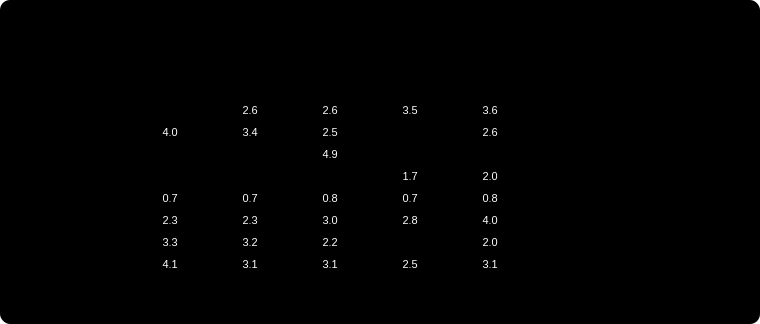
Table
| unit | The | sun | rises | in | the |
|---|---|---|---|---|---|
| L3/H4 | 1.628 | 2.600 | 2.583 | 3.546 | 3.562 |
| L0/H6 | 4.026 | 3.410 | 2.513 | 2.185 | 2.614 |
| L0/H7 | 1.035 | 1.029 | 4.852 | 2.510 | 0.727 |
| L5/N1296+ | 0.000 | 0.732 | 0.167 | 1.728 | 1.978 |
| L3/H3 | 0.663 | 0.677 | 0.771 | 0.699 | 0.802 |
| L2/H4 | 2.287 | 2.269 | 2.994 | 2.845 | 4.017 |
| L0/H4 | 3.330 | 3.172 | 2.195 | 1.203 | 2.005 |
| L1/H1 | 4.075 | 3.105 | 3.088 | 2.498 | 3.098 |

Table
| token | before | after |
|---|---|---|
| sky | 6.06% | 0.15% |
| middle | 3.66% | 1.02% |
| morning | 3.19% | 0.68% |
| distance | 1.59% | 0.01% |
| north | 1.45% | 0.08% |

Table
| group | kind | status | members |
|---|---|---|---|
| EleutherAI--pythia-70m/L1/H6/HUB | hub | VERIFIED | L1/H6 |
Mechanism
The units that carry the answer, as they stood then.
Read more
Shares are of first-order attribution on this prompt. Only a VERIFIED unit's explanation is shown. A broad unit is VERIFIED but active on at least half of its held-out text, so its explanation says little about this one prompt.
| Unit | Kind | Share | Attribution | Status then | Explanation |
|---|---|---|---|---|---|
| L3/H4 | head | 1.3% | -3.184 | unstudied broad | |
| L0/H6 | head | 0.77% | +1.952 | unstudied broad | |
| L0/H7 | head | 0.48% | -1.209 | unstudied | |
| L5/N1296+ | pole | 0.37% | -0.938 | unstudied | |
| L3/H3 | head | 0.36% | -0.915 | VERIFIED | Induction-style head: active on the second (or later) occurrence of a rare word, name or identifier that splits into several tokens, typically on its first or middle pieces ('k' of a repeated 'xkcd', 'organic' of a repeated 'Inorganic', 'ull' of a repeated 'Skullpocket'), where it attends to the token that followed the earlier copy. A first mention of the same word is inactive. Ordinary prose with no repeated rare word is inactive; repeated common words (the, of, and), list commas and parallel list items ('Monday ..., Tuesday ..., Wednesday') rarely and only weakly cross the line (about 0.25-0.35 of max). |
| L2/H4 | head | 0.34% | -0.873 | stopped broad | |
| L0/H4 | head | 0.33% | +0.842 | unstudied broad | |
| L1/H1 | head | 0.33% | -0.830 | unstudied broad | |
| L1/H7 | head | 0.31% | -0.775 | unstudied broad | |
| L0/H1 | head | 0.30% | +0.756 | VERIFIED | Active (above 0.25 of max) on (1) every '\n' token that has another newline token among the previous 4 tokens (blank lines, short lines such as headings, 'A:', menu items; peak 0.5-0.9 of max), or that ends a line whose last token is '.', '?', ':', '{' or ').' (0.27-0.4), while a lone '\n' after a word, number, comma, quote or closing bracket stays inactive; and (2) in running prose, only on the word right after ' is', ' was', ' are', ' has', ' in', ' at' or sentence-initial 'In' when that word is a determiner, possessive or quantifier (the, a, an, my, her, this, one, what, all) or 'In addition/fact/order/terms' (0.26-0.44), plus, about 40% of the time, the curly apostrophe after a pronoun in contractions like 'I’m'. Every other prose token, including determiners after ' to', ' on', ' with', ' by', ' from', ' and', ' that', a comma or a noun, is predicted inactive; ' of the' and ' for the' are borderline (about 0.22-0.25, mostly inactive). |
| L5/H0 | head | 0.28% | -0.722 | unstudied | |
| L2/H5 | head | 0.28% | -0.712 | unstudied broad | |
| L1/H0 | head | 0.28% | +0.700 | unstudied | |
| L1/H5 | head | 0.27% | +0.678 | unstudied | |
| L4/H1 | head | 0.26% | -0.650 | unstudied broad | |
| L2/H3 | head | 0.25% | -0.627 | VERIFIED broad | Most-recent-noun copier: from each token the head attends back to the nearest noun or pronoun that came after the text's first token and writes it, so it crosses the line on such a noun and the 1-3 tokens after it. It is reliably above the line when a common noun brought in by a determiner, adjective or comma (the weather, further studies, the results, 'eggs, flour,') is followed by its verb or auxiliary (peak 0.9-2.6 on was/are/is/have/did and the next word), and on the random letters of a URL ID after '/' (t.co/aB3dE5); it reliably stays below when no noun or pronoun follows the first word: one- or two-word texts, a single clause opened by a pronoun or name followed only by verbs, adverbs and adjectives ('He never came back again after all.', 'John is always early and never late.'), a subject noun that is itself the first word ('Rain then stopped.'), and runs of single letters, plain numbers, one repeated word or one repeated symbol; later personal pronouns (I, you, he, she, we, they, him, them) as the only subjects give 0.3-0.8 and cross about half the time, 'it'/'this' subjects usually cross, object nouns late in a clause and short code usually stay below, and almost any natural prose of 12+ tokens containing 'the + noun + verb' crosses. |
| L0/N354+ | pole | 0.24% | -0.602 | unstudied | |
| L1/H6 | head | 0.23% | -0.590 | VERIFIED broad | L1/H6 is a broad copy head: each token attends to one earlier word, usually 1-7 back, and copies that word's value. Almost any text of 8+ tokens that contains ordinary words crosses the line (measured 24/30 plain prose sentences at 0.85-1.4, usually on the noun or verb after the subject). It is strong (1.5-2.6, about 0.5-0.75 of max) on the noun after a demonstrative 'that' ('paid that bill', 'that's', 'that is') and on 'is' or the adjective after a subject 'it' ('it is possible/likely/clear'). The narrow class that reliably stays below the line is text with no letters at all: comma-separated lists of plain numbers (integers or decimals, optionally negative, with no '$', '=', '*' or words), which peak at 0.0-0.6 because commas and digits copy almost nothing. |
| L1/H2 | head | 0.23% | +0.575 | VERIFIED broad | Dense previous-token head that crosses the line on almost any text longer than a few tokens: strongest on the second piece of a word or name the tokenizer splits (Mac|mill, Mc|Av, bark|ed, cheer|ed), the token after ' there' ('s, is, be), an abbreviation's period, whitespace runs, list numbers, URLs and code, and it also crosses on the 2nd-4th tokens of any text that does not open with 'The' (A dog ate..., He kicked..., Mary won...) and on the token after ' and', ' on', ' over', ' near', ' all' or ' first'. It stays below the line only on (a) one single-token word followed by '.' ('Water.', 'Sorry.', 'True.') and (b) texts made only of 'The'-opened simple clauses of single-token everyday words, 'The N.', 'The N V.' or 'The N V the N.', one or several in a row, with no split word, adjective, preposition, 'and', comma, number, pronoun or name (known exceptions that still fire: ' door', ' way', ' other', ' same', ' time' after 'the'). |
| L2/H6 | head | 0.22% | +0.557 | unstudied |