 Open Interpretability
Why EleutherAI/pythia-70m answers sky
The sun rises in the
Answer understood: a route claim is VERIFIED
The claim (answer experiment 1, VERIFIED): Layer-0 token detectors (N513, N1335, N353, N1418) write a 'sun' identity feature at the subject position, and L0/N1669 marks the final ' the' as a determiner. Copy heads L1/H6 and L2/H3 move the 'sun' feature from ' sun' to the last position, while L0/H1 brings the ' in' frame there. L5/H7 and L5/N1677+ turn 'sun-like subject + in the' into ' sky'. Swap the subject for a non-sky noun and the copied feature changes, so the answer changes; swap it for another sky object (moon, stars, clouds) and the answer stays.
Answer experiments, newest first
| Experiment | Verdict | Route | Necessity | Sufficiency | Patching | Failed gates |
|---|---|---|---|---|---|---|
| attempt 1 | VERIFIED | L0/H0 → L0/H1 → L0/H2 → L0/N513+ → L0/N1335+ → L0/N353+ → L0/N1418+ → L0/N1669+ → L1/H6 → L2/H3 → L3/H3 → L5/H7 → L5/N1677+ | 73% | 54% | 86% | none |
| attempt 1 | VERIFIED | L0/H0 → L0/H1 → L0/H2 → L0/N513+ → L0/N1335+ → L0/N353+ → L0/N1418+ → L0/N1669+ → L1/H6 → L2/H3 → L3/H3 → L5/H7 → L5/N1677+ | 73% | 54% | 86% | none |
| attempt 1 | VERIFIED | L0/H0 → L0/H1 → L0/H2 → L0/N513+ → L0/N1335+ → L0/N353+ → L0/N1418+ → L0/N1669+ → L1/H6 → L2/H3 → L3/H3 → L5/H7 → L5/N1677+ | 73% | 54% | 86% | none |
| attempt 1 | VERIFIED | L0/H0 → L0/H1 → L0/H2 → L0/N513+ → L0/N1335+ → L0/N353+ → L0/N1418+ → L0/N1669+ → L1/H6 → L2/H3 → L3/H3 → L5/H7 → L5/N1677+ | 73% | 54% | 86% | none |
Each experiment's page defines these measures and shows its tests.
Written UTC with openinterpretability 0.1.0, narrated by external/claude-sonnet-5-5 · Source
One of 7 explanations of this prompt, aimed at 75% causal coverage.
Read more
Level: long. It builds on the explanation of 2026-11-17 20:07, which reached 52%; this one reaches 75%.It can't be measured again: it was written before explanation records stored their inputs (#4793).
- Explained
- 4.5%
- Prompt coverage
- 75%
- Random units (not matched)
- -0.094%
- Experiments needed
- 17,066
Coverage alone does not show that the answer is understood: the VERIFIED route claim above does.
Why
Verified units hold 4.5% of the attribution, and keeping them brings back 75% of the answer, against -0.094% for random units not matched by kind and layer. Their explanations describe each unit on its scan corpus, not its role in this answer.
Figures
Read more
Drawn from this explanation's measured data, each with its table below it. A VERIFIED explanation describes its unit on the scan corpus, not on this prompt, so the coverage figure is the causal check.

Table
| from | to | weight |
|---|---|---|
| L2/H4 | L3/H4 | −0.590 |
| L3/H3 | L5/N1296+ | −0.290 |
| L2/H3 | L5/N1296+ | −0.268 |
| L2/H3 | L3/H4 | −0.255 |
| L1/H7 | L3/H4 | −0.255 |
| L0/H6 | L3/H3 | 0.238 |
| L3/H4 | L5/N1296+ | −0.238 |
| L1/H6 | L5/N1296+ | −0.226 |
| L1/H7 | L2/H4 | −0.216 |
| L2/H3 | L3/H3 | 0.200 |
| L1/H6 | L3/H4 | −0.194 |
| L0/H7 | L3/H4 | −0.192 |
| L0/N354+ | L2/H4 | −0.190 |
| L0/H4 | L2/H4 | 0.186 |
| L2/H4 | L5/N1296+ | −0.182 |
| L0/H4 | L3/H3 | 0.178 |
| L0/H6 | L1/H1 | 0.176 |
| L0/H6 | L2/H4 | 0.169 |
| L0/H4 | L1/H1 | −0.164 |
| L0/H6 | L5/N1296+ | 0.155 |
| L2/H6 | L3/H4 | 0.152 |
| L0/H4 | L5/N1296+ | 0.151 |
| L1/H5 | L2/H4 | 0.140 |
| L1/H0 | L5/N1296+ | 0.138 |
| L0/H7 | L3/H3 | −0.137 |
| L0/H1 | L1/H1 | −0.136 |
| L2/H4 | L3/H3 | 0.135 |
| L1/H0 | L2/H4 | 0.131 |
| L1/H5 | L3/H4 | 0.130 |
| L0/H1 | L5/N1296+ | −0.123 |
| L0/H6 | L3/H4 | 0.121 |
| L1/H2 | L2/H4 | 0.120 |
| L0/N354+ | L1/H1 | −0.117 |
| L0/H4 | L3/H4 | 0.106 |
| L1/H0 | L3/H4 | −0.100 |
| L1/H1 | L2/H4 | −0.099 |
| L0/H1 | L2/H4 | −0.096 |
| L2/H6 | L3/H3 | 0.094 |
| L1/H7 | L3/H3 | −0.090 |
| L1/H7 | L5/N1296+ | −0.081 |

Table
| unit | attribution | kind |
|---|---|---|
| L3/H4 | −3.183 | explained |
| L0/H6 | 1.952 | unstudied |
| L0/H7 | −1.210 | unstudied |
| L5/N1296+ | −0.938 | unstudied |
| L3/H3 | −0.915 | explained |
| L2/H4 | −0.873 | blocked |
| L0/H4 | 0.842 | explained |
| L1/H1 | −0.830 | unstudied |
| L1/H7 | −0.775 | unstudied |
| L0/H1 | 0.756 | explained |
| L5/H0 | −0.722 | unstudied |
| L2/H5 | −0.712 | unstudied |
| L1/H0 | 0.700 | unstudied |
| L1/H5 | 0.678 | unstudied |
| L4/H1 | −0.650 | unstudied |
| L2/H3 | −0.627 | explained |
| L0/N354+ | −0.602 | explained |
| L1/H6 | −0.590 | explained |
| L1/H2 | 0.575 | explained |
| L2/H6 | 0.557 | unstudied |
| the rest | −7.193 | rest |

Table
| set | coverage |
|---|---|
| explained units | 75.06% |
| random 1 | 0.11% |
| random 2 | 0.88% |
| random 3 | -0.24% |
| random 4 | -1.12% |
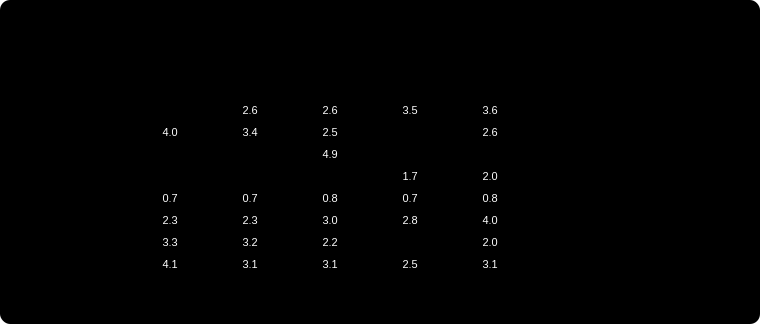
Table
| unit | The | sun | rises | in | the |
|---|---|---|---|---|---|
| L3/H4 | 1.628 | 2.600 | 2.583 | 3.546 | 3.562 |
| L0/H6 | 4.026 | 3.410 | 2.513 | 2.185 | 2.614 |
| L0/H7 | 1.035 | 1.029 | 4.852 | 2.510 | 0.727 |
| L5/N1296+ | 0.000 | 0.732 | 0.167 | 1.728 | 1.978 |
| L3/H3 | 0.663 | 0.677 | 0.771 | 0.699 | 0.802 |
| L2/H4 | 2.287 | 2.269 | 2.994 | 2.845 | 4.017 |
| L0/H4 | 3.330 | 3.172 | 2.195 | 1.203 | 2.005 |
| L1/H1 | 4.075 | 3.105 | 3.088 | 2.498 | 3.098 |

Table
| token | before | after |
|---|---|---|
| sky | 6.06% | 0.15% |
| middle | 3.66% | 0.45% |
| morning | 3.19% | 0.12% |
| distance | 1.59% | 0.02% |
| north | 1.45% | 0.04% |

Table
| group | kind | status | members |
|---|---|---|---|
| EleutherAI--pythia-70m/L1/H6/HUB | hub | VERIFIED | L1/H6 |
In one paragraph
The model answered " sky", but the answer is mostly not understood yet. Only 4.47% of first-order attribution is explained and 95.53% is unexplained (0.78% blocked). Prompt coverage is 0.7506 against -0.00094 for random units. Eight VERIFIED units are involved: L3/H4, L3/H3, L0/H4, L0/H1, L2/H3, L0/N354+, L1/H6 and L1/H2. Their corpus-based explanations (for example L0/N354+ detects 'in', and L3/H4 and L0/H4 are previous-token heads) do not mention the sun or the sky, so how they produce " sky" is unknown. L1/H6 is a hub centre and may be an artefact. Ablating the 8 verified poles together changes the logit by 1.0912 and flips the top token to " city", so they matter causally. Large unverified units include L0/H6, L0/H7, L5/N1296+, L1/H1, L1/H7 and the stopped L2/H4, and their roles are unknown. The next experiments are explore runs, led by L0/N195+ (coverage gain 0.0128), L5/H0 (0.0057) and L3/N945+ (0.0035).
The long form
How much is explained
The model answered " sky" to "The sun rises in the". Only 4.47% of the first-order attribution on this prompt is explained by verified units. 95.53% is unexplained, and 0.78% is blocked. The listed units cover 0.7506 of the prompt (prompt coverage), against -0.00094 for random units, so the listed units are far from random. Even so, the answer is mostly not understood yet. Shares are of first-order attribution, so they do not measure how much of the computation is understood.
What the verified units are known to do
Eight units are VERIFIED. Their explanations describe the unit on a scan corpus, so they may not cover this prompt. None of them mentions the sun, the sky, or the word "sky", so the evidence does not say how any of them leads to " sky".
L0/N354+ is a context-free detector for the prepositions 'in' and 'at' and close relatives. The prompt contains ' in', which that explanation grades at 1.91 of a 2.25 maximum. Its share is 0.0024 and its attribution is -0.6021. That its activation here comes from ' in' is an inference from the explanation. The evidence has no activation for this prompt.
L0/H4 and L1/H2 are previous-token heads (shares 0.0033 and 0.0023). L1/H6 is a broad copy head (share 0.0023). L2/H3 copies the most recent noun (share 0.0025). L0/H1 fires in prose on the word after ' in', ' is' and the like when that word is a determiner such as 'the' (share 0.0030). L3/H3 is an induction-style head for repeated rare words (share 0.0036), and L3/H4 is a broad previous-token head that locks onto the specifier opening a phrase (share 0.0125). The evidence does not say whether these descriptions hold on this short prompt. It gives no activation for any of them here, only attribution and ablation numbers.
L1/H6 is the centre of a hub (norm 4.06, layer median 4.10, percentile 0.25), wired to many studied units. The notes say such a unit can be an artefact, so its role here is uncertain.
What the verified units do together
The largest single unit by share is L3/H4 (0.0125, attribution -3.1835, VERIFIED). Ablating it gives an ablation change of 2.8396. The evidence does not say what the sign or scale of that change mean for the answer. Ablating the 8 verified poles together changes the logit by 1.0912 and changes the top token from " sky" to " city". So the verified units are causally involved in the answer, but the evidence does not show what they compute.
The paths in the evidence link units. For example, L2/H4 feeds L3/H4 (weight -0.5895), and L3/H3, L2/H3, L3/H4 and L1/H6 all feed L5/N1296+ (weights -0.29, -0.27, -0.24 and -0.23). L2/H4 is stopped and L5/N1296+ is unstudied (share 0.0037, attribution -0.9382, ablation change 0.5723), so their roles are unknown.
Unverified units
Several other units have large shares but no known role. They are unverified, and the evidence gives only their attribution and ablation. L0/H6 has share 0.0077, attribution 1.9516 and ablation change -2.3035. L0/H7 has share 0.0048, attribution -1.2095 and ablation change 1.02. L1/H1 has share 0.0033 and ablation change 1.097. L1/H7 has share 0.0031 and ablation change 0.8029. L2/H4 is stopped (share 0.0034, ablation change 1.635). L5/H0, L2/H5, L1/H0, L1/H5, L4/H1 and L2/H6 are unstudied and have no ablation value. L5/N1296+ is the unstudied target of several paths, and what it does is unknown.
What is not known yet
Not known: why the model says " sky" and not " city" or any other token. Nothing verified in the evidence relates to the content of the answer. 95.53% of the attribution is unexplained. The role of every unverified unit above is unknown, including L0/H6, L0/H7, L5/N1296+, L1/H1, L1/H7 and the stopped L2/H4. Whether the corpus-based explanations of the eight verified units hold on this prompt is also not known.
The next experiments listed in the evidence are all explore runs on unstudied units, with the coverage gain they would add: L0/N195+ (0.0128), L5/H0 (0.0057), L3/N945+ (0.0035), L3/N395+ (0.0031), L1/N687+ (0.0025), L5/N659+ (0.0017) and L3/N371+ (0.0013). L2/N898+, L3/N1920+ and L4/N494+ would add 0.0. L0/N195+ is the largest listed gain. L5/H0 is the one unit among them that already has attribution on this prompt (share 0.0028).
Mechanism
The units that carry the answer, as they stood then.
Read more
Shares are of first-order attribution on this prompt. Only a VERIFIED unit's explanation is shown. A broad unit is VERIFIED but active on at least half of its held-out text, so its explanation says little about this one prompt.
| Unit | Kind | Share | Attribution | Status then | Explanation |
|---|---|---|---|---|---|
| L3/H4 | head | 1.3% | -3.184 | VERIFIED broad | Broad, mostly previous-token head: predict ordinary prose active-weak (most sentences of a dozen or more tokens have one or two tokens just over the line, roughly 10% of tokens, peaks near 0.3-0.45 of max), and it is strong (above ~0.6 of max) on a content word, or a later sub-word piece of a name or term, whose attention falls almost wholly (weight ~0.9) on the specifier opening its phrase: 'which' ('regardless of which system'), numerals ('the two Kivu'), 'every', 'any', possessives 'its'/'their', 'a' after a preposition ('At a global'), 'of' in 'some of / one of' before a name, 'are' in 'There are further', or the head noun before a name ('regional capital Białystok'); it is weak after 'the', 'this', 'that'. Comma lists of plain numbers and strings of one-word exclamations ('Stop. Yes! Okay?') are inactive. |
| L0/H6 | head | 0.77% | +1.952 | unstudied broad | |
| L0/H7 | head | 0.48% | -1.209 | unstudied | |
| L5/N1296+ | pole | 0.37% | -0.938 | unstudied | |
| L3/H3 | head | 0.36% | -0.915 | VERIFIED | Induction-style head: active on the second (or later) occurrence of a rare word, name or identifier that splits into several tokens, typically on its first or middle pieces ('k' of a repeated 'xkcd', 'organic' of a repeated 'Inorganic', 'ull' of a repeated 'Skullpocket'), where it attends to the token that followed the earlier copy. A first mention of the same word is inactive. Ordinary prose with no repeated rare word is inactive; repeated common words (the, of, and), list commas and parallel list items ('Monday ..., Tuesday ..., Wednesday') rarely and only weakly cross the line (about 0.25-0.35 of max). |
| L2/H4 | head | 0.34% | -0.873 | stopped broad | |
| L0/H4 | head | 0.33% | +0.842 | VERIFIED broad | Broad previous-token head: predict ordinary prose, code and number lists active-weak (about 0.25-0.55 of max), but predict inactive a two-token text made of one lowercase common word that is a single token followed only by '.', '!' or '?' (e.g. 'cat.', 'road!', 'tree?'; capitalised words like 'Okay.' and words split into pieces like 'gar|den.' do not count). It is strong (above about 0.6 of max) on the second piece of a word split into sub-word tokens after a short, usually capitalised or all-caps, word-start fragment it attends to (GRE|ATER, PR|OT, PL|URAL, Cle|aring, Hod|ges, De Kal|b, CM|ake, url|pattern), and on fixed pairs such as Highway + route number, UPDATE ... SET and 'Story highlights'. |
| L1/H1 | head | 0.33% | -0.830 | unstudied broad | |
| L1/H7 | head | 0.31% | -0.775 | unstudied broad | |
| L0/H1 | head | 0.30% | +0.756 | VERIFIED | Active (above 0.25 of max) on (1) every '\n' token that has another newline token among the previous 4 tokens (blank lines, short lines such as headings, 'A:', menu items; peak 0.5-0.9 of max), or that ends a line whose last token is '.', '?', ':', '{' or ').' (0.27-0.4), while a lone '\n' after a word, number, comma, quote or closing bracket stays inactive; and (2) in running prose, only on the word right after ' is', ' was', ' are', ' has', ' in', ' at' or sentence-initial 'In' when that word is a determiner, possessive or quantifier (the, a, an, my, her, this, one, what, all) or 'In addition/fact/order/terms' (0.26-0.44), plus, about 40% of the time, the curly apostrophe after a pronoun in contractions like 'I’m'. Every other prose token, including determiners after ' to', ' on', ' with', ' by', ' from', ' and', ' that', a comma or a noun, is predicted inactive; ' of the' and ' for the' are borderline (about 0.22-0.25, mostly inactive). |
| L5/H0 | head | 0.28% | -0.722 | unstudied | |
| L2/H5 | head | 0.28% | -0.712 | unstudied broad | |
| L1/H0 | head | 0.28% | +0.700 | unstudied | |
| L1/H5 | head | 0.27% | +0.678 | unstudied | |
| L4/H1 | head | 0.26% | -0.650 | unstudied broad | |
| L2/H3 | head | 0.25% | -0.627 | VERIFIED broad | Most-recent-noun copier: from each token the head attends back to the nearest noun or pronoun that came after the text's first token and writes it, so it crosses the line on such a noun and the 1-3 tokens after it. It is reliably above the line when a common noun brought in by a determiner, adjective or comma (the weather, further studies, the results, 'eggs, flour,') is followed by its verb or auxiliary (peak 0.9-2.6 on was/are/is/have/did and the next word), and on the random letters of a URL ID after '/' (t.co/aB3dE5); it reliably stays below when no noun or pronoun follows the first word: one- or two-word texts, a single clause opened by a pronoun or name followed only by verbs, adverbs and adjectives ('He never came back again after all.', 'John is always early and never late.'), a subject noun that is itself the first word ('Rain then stopped.'), and runs of single letters, plain numbers, one repeated word or one repeated symbol; later personal pronouns (I, you, he, she, we, they, him, them) as the only subjects give 0.3-0.8 and cross about half the time, 'it'/'this' subjects usually cross, object nouns late in a clause and short code usually stay below, and almost any natural prose of 12+ tokens containing 'the + noun + verb' crosses. |
| L0/N354+ | pole | 0.24% | -0.602 | VERIFIED | Context-free single-token detector (layer 0, activation depends only on the current token's identity; identical after any prefix) for the locative/temporal prepositions 'in' and 'at' and their close relatives, graded: ' In' 2.25 (max) > 'In' 2.16 > ' At' 1.93 > ' in' 1.91 > ' в' 1.76 > ' at' 1.61 > 'At' 1.55 > 'В'/' В' 1.4-1.5 > ' Dans' 1.36 > ' IN' 1.34 > ' During' 1.32 > 'Within'/'during'/' Within' 1.16-1.26 > 'According' 1.21 > 'at' 1.12 > 'Under'/' during'/' dans'/' within'/' According' ~1.07-1.10 > ' Under' 0.98, ' AT' 0.97, ' under' 0.91, 'Into' 0.88, 'in' 0.72, 'under'/'within' 0.71, ' Inside' 0.61, ' Along' 0.75, plus foreign 'in/at' prepositions (' στην', ' во', '在', ' unter', ' în', ' في', ' nel', ' dentro', ' durante', ' depuis', ' sous', ' bei') and a long tail of ~600 mostly rare word-fragment tokens just above the 0.563 line (e.g. ' terr', ' fab', ' cryst', ' enh', ' inhab', ' attending', ' attend', ' pursuant'); every other common function word is predicted inactive, including named near-misses ' Outside' 0.585/' outside' 0.27, ' inside' 0.50, ' Behind' 0.44, ' Near' 0.44/' near' 0.29, ' As' 0.47, 'IN' 0.49, ' Following' 0.31, ' Throughout' 0.38, ' throughout' 0.55, ' Into'/' into' 0.29/0.11, ' On'/' on' 0.16/<0, and ' of', ' for', ' from', ' by', ' with', ' to', ' after', ' before', ' Among', ' Between', ' Since', ' Upon' (all <=0.1). |
| L1/H6 | head | 0.23% | -0.590 | VERIFIED broad | L1/H6 is a broad copy head: each token attends to one earlier word, usually 1-7 back, and copies that word's value. Almost any text of 8+ tokens that contains ordinary words crosses the line (measured 24/30 plain prose sentences at 0.85-1.4, usually on the noun or verb after the subject). It is strong (1.5-2.6, about 0.5-0.75 of max) on the noun after a demonstrative 'that' ('paid that bill', 'that's', 'that is') and on 'is' or the adjective after a subject 'it' ('it is possible/likely/clear'). The narrow class that reliably stays below the line is text with no letters at all: comma-separated lists of plain numbers (integers or decimals, optionally negative, with no '$', '=', '*' or words), which peak at 0.0-0.6 because commas and digits copy almost nothing. |
| L1/H2 | head | 0.23% | +0.575 | VERIFIED broad | Dense previous-token head that crosses the line on almost any text longer than a few tokens: strongest on the second piece of a word or name the tokenizer splits (Mac|mill, Mc|Av, bark|ed, cheer|ed), the token after ' there' ('s, is, be), an abbreviation's period, whitespace runs, list numbers, URLs and code, and it also crosses on the 2nd-4th tokens of any text that does not open with 'The' (A dog ate..., He kicked..., Mary won...) and on the token after ' and', ' on', ' over', ' near', ' all' or ' first'. It stays below the line only on (a) one single-token word followed by '.' ('Water.', 'Sorry.', 'True.') and (b) texts made only of 'The'-opened simple clauses of single-token everyday words, 'The N.', 'The N V.' or 'The N V the N.', one or several in a row, with no split word, adjective, preposition, 'and', comma, number, pronoun or name (known exceptions that still fire: ' door', ' way', ' other', ' same', ' time' after 'the'). |
| L2/H6 | head | 0.22% | +0.557 | unstudied |